
TESTING FLORA AI: 5 LESSONS FOR CREATIVE TEAMS
I'll be honest, as a Senior Art Director, anything that promises to make creative work faster, easier or smarter tends to put me on edge. In my experience, it usually goes one of two ways. Either it's the best thing since sliced bread, or it spits out 47 versions of the same, slightly average, idea and calls it innovation.
Flora has turned out to be a bit different.
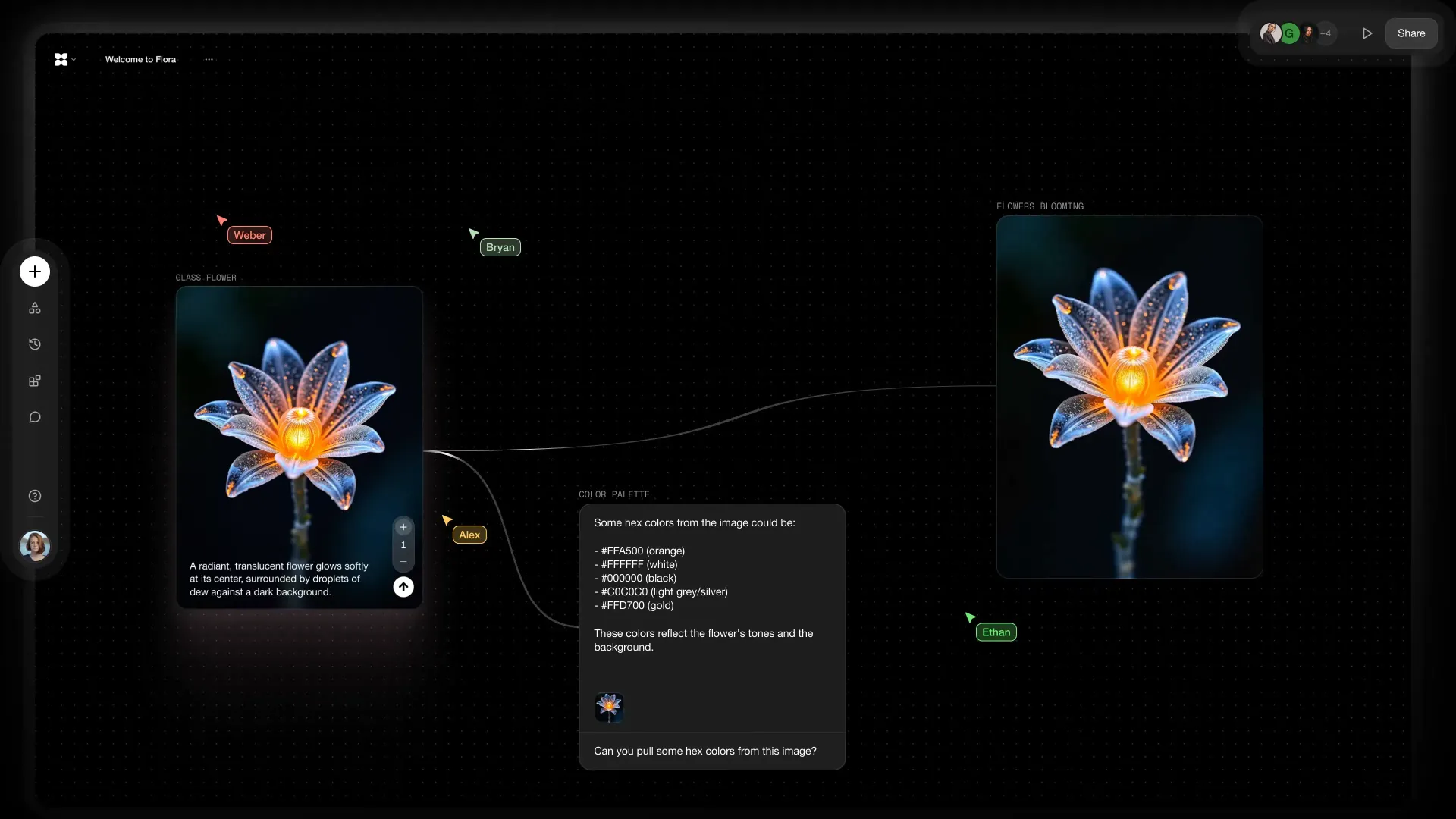
It's not just another AI design tool you mind-dump prompts into. It describes itself as an AI-powered canvas for designers, brand teams and agencies - bringing text, image and video models together in one workspace.
In plain English, it's somewhere to think, make, test, compare, break things, rebuild them and occasionally find yourself muttering, “ooooh, that's actually not bad."
As a creative agency, we're always interested in tools that can help us explore ideas differently. Not because we're looking to replace creativity, but because we're curious about how AI and creativity can work together in practice.
Here's what we've learnt about Flora in the short time we've had it.
1. It feels like a workspace, not an AI toy
The canvas is great.
Instead of firing a prompt into the void and hoping something useful comes back, you build things visually. References, prompts, outputs, edits and alternative directions all sit together on one board.
This works better, because creative thinking is never a straight line. Nobody goes from brief to finished answer in one clean step. We go back and forth and compare things side by side. We steal a bit from one route and shove it into another. We get annoyed and walk away for a bit to get perspective. And then we come back a day later and realise the "bad" idea actually had legs.
Flora's canvas embraces the mess that leads to a brilliant result, and it's a much better fit for how creative work actually unfolds, as opposed to the tidy, one-shot process most AI design tools seem to assume.
2. It’s great for exploring fast, but humans still need to hold the reins
Flora talks a big game about helping teams explore hundreds of possibilities across text, image and video.
The upside is obvious - you can get to a much wider range of visual directions, and fast. For early concepting, moodboards, campaign territories and those "what if we pushed it this way?" conversations, that speed quickly brings to life questions and ideas without wasting too much time or resource.
The catch is, having more options doesn’t always mean having better ideas. Sometimes you just create more things to scroll through, and having a bigger pile isn't a strategy.
That's why conversations about AI and creativity often miss the point. The value isn't in generating endless possibilities. It's in knowing which possibilities are worth pursuing. An art director's job hasn't gone anywhere - if anything, experience and judgment matters more now.
Someone still needs to know what's right, what's close and what should be quietly left behind.
3. Why Flora could be a valuable tool for creative work
Where Flora starts to feel really helpful for a creative agency is repeatability.
A lot of AI tools feel as though they work best for individual experimentation. Flora has the potential to scale ideas and turn concepts into a proper volume of creative output.
That means things like:
- Campaign territories
- Moodboards
- Pitch visuals
- Storyboards
- Social concepts
- Asset variations
- Visual systems
- Client presentation stimulus
The tool doesn't feel like it's replacing the creative process, it feels like giving us a better studio to work in.
Remember the desk covered in marker pens, magazine cuttings, scalpels, sketchbooks and Pantone books? Imagine all of that folded into one digital workspace that's collaborative, organised and infinitely expandable. That's probably the closest comparison.

4. The video tools are exciting, but let's not get carried away
The video side is probably the most exciting part of the whole platform.
Flora combines text prompts, reference images, storyboards and existing footage to generate cinematic video outputs, all within the same creative environment.
For a creative agency, that's useful in helping to develop pitch decks, campaign films, animatics and visual concepts before production begins.
Being able to demonstrate movement, mood and atmosphere this early in the process feels like a real shift. And a shift that will really benefit brands and clients too.
But, I'd still be careful with the phrase "production-ready". For selling an idea, testing a concept or helping a client visualise a direction, it's brilliant.
For final branded work, it still needs the same scrutiny as anything else does. Craft, consistency, rights, detail, brand fit and a quick check that nobody's mysteriously grown an extra finger. The technology is impressive, there’s no denying that. But professional judgement is still essential.
5. The real win isn't the output - it's making the thinking visible
Honestly, the most useful part of Flora might not be the finished outputs at all. For me, it’s the fact that it captures the entire journey of getting there.
Because everything lives on one canvas, you can see how an idea evolves. The references, the dead ends, the near misses, the iterations and the final direction all exist in the same space.
Firstly, that's useful for us internally. But it could be even more useful for clients and brands.
One of the biggest challenges for any creative agency is helping people understand the thinking behind the work. Flora gives us a way to show that thinking more clearly.
AI often gets criticised for making creative work feel disposable. Used well, Flora could do the opposite. It shines a light on the process, rather than hiding it.
So, what's the verdict?
Flora isn't a magic creative button (thankfully). The creative industry has never been short of tools that promise miracles and deliver very little.
What Flora does offer is a better environment for exploring ideas, iterating quickly and getting to the interesting stuff faster. As an AI design tool, its real value isn't replacing talented people. It's helping creative teams move wider, faster and with more confidence.
The future of AI and creativity probably isn't about automation taking over the creative process. It's about giving creative people better ways to explore, test and develop ideas.
The trick is treating the technology as a tool, not a department. Let it help speed up the process, and think bigger. But leave the judgment, craft, taste and intent firmly with the humans.
Talking of talented humans – take a look at some of our creative work here.